


Drone Motors vs Regular Motors: What Really Makes Them Different?
A source-backed guide to motor architecture, KV, thrust, thermal limits and propulsion-system selection.
Executive summary
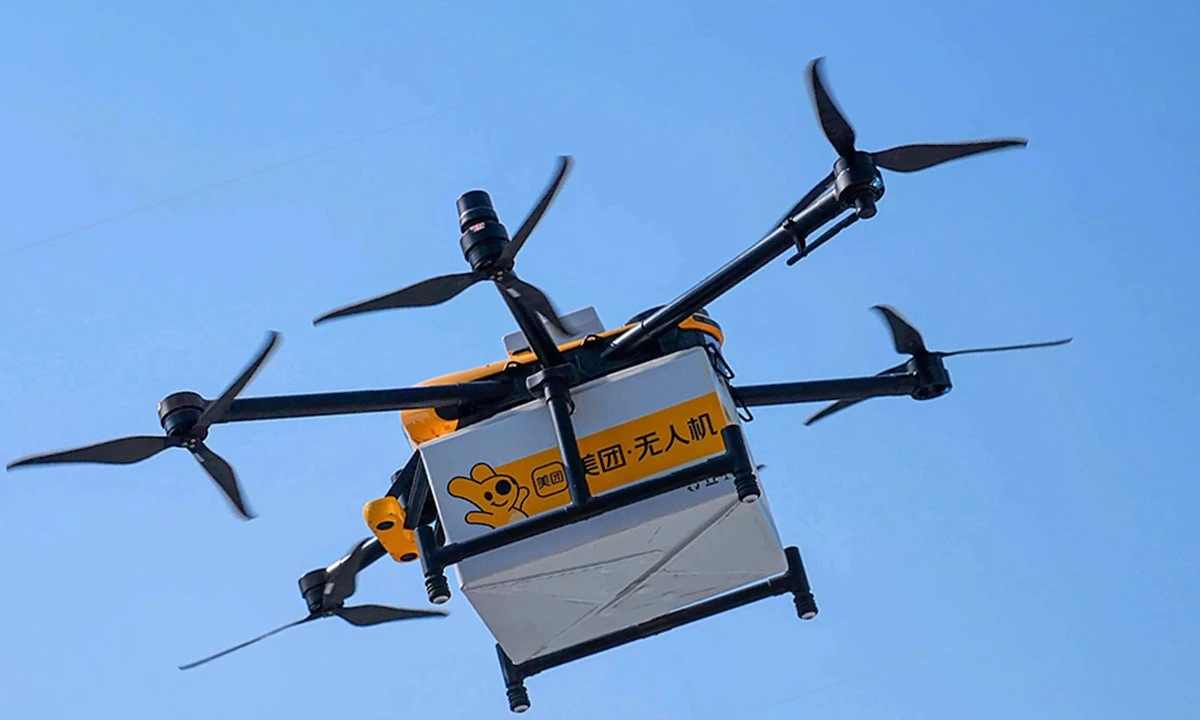
A drone motor is not a separate species of electric motor. It is usually a permanent-magnet brushless motor selected as part of a tightly matched propulsion system — motor, electronic speed controller, battery and propeller — where mass, thrust, response and cooling matter together. "Regular motor" can mean brushed DC, industrial induction, servo or even another BLDC motor, so the right comparison is application versus application, not one motor label versus every other motor. The aircraft also carries non-propulsion actuators whose low-speed precision, gearing, vibration and duty requirements can be very different from lift propulsion.
The six differences that matter
Start here before comparing isolated RPM, wattage or KV figures.
- System role: a propulsion motor is chosen with its propeller, voltage and ESC.
- Construction: many multirotors use outrunner BLDC motors, but inrunners and other architectures also exist.
- Ratings: KV is a speed constant, not a power or quality score.
- Performance: thrust and current are specific to the exact motor-propeller-voltage combination.
- Thermals: allowed current depends on duration, airflow, speed, ambient temperature and winding limits.
- Selection: compare test tables under the same conditions, not headline specifications from different duty cycles.
Scope: this guide compares common engineering tendencies, not universal rules. The exact motor, propeller, voltage, controller, airflow and duty cycle always take priority.
A "drone motor" describes an optimized application, not a unique motor category
Modern electric multirotors commonly use permanent-magnet brushless motors because compact construction, electronic commutation and fast controller-driven response fit the needs of flight. Many are outer-rotor, or "outrunner," designs that can drive a propeller directly. But none of those traits belongs only to drones: industrial equipment, appliances, medical devices and robots also use BLDC motors, while some small toy aircraft still use brushed motors.
The practical difference is the optimization target. A multirotor propulsion system must create enough thrust to hover, retain control margin for maneuvering, minimize airborne mass and respond quickly to commands. A pump, conveyor or fan may instead prioritize continuous shaft output, enclosure protection, predictable temperature rise, acoustic performance, service life or low cost.
That distinction fixes the biggest weakness in simplistic comparisons. Saying "drone motors are brushless while ordinary motors have brushes" is false. Saying "drone motors are always high KV" is also false. The useful question is: which motor architecture, winding, controller, voltage and load best satisfy this mission?
How drone propulsion motors and common general-purpose motors differ
The table compares common design tendencies, not universal rules. A specific product may sit outside any one row, so the manufacturer's drawing, operating curve and test conditions always take priority.
| Decision factor | Multirotor propulsion motor | Typical general-purpose motor example |
|---|---|---|
| Primary job | Turn electrical power into controlled propeller thrust with minimum airborne mass. | Deliver torque or speed to a fixed load such as a pump, fan, wheel, gearbox or conveyor. |
| Common construction | Permanent-magnet BLDC/PMSM; outrunners are common, but not exclusive. | Brushed DC, inner-rotor BLDC, AC induction, synchronous PM, stepper or servo. |
| Controller | ESC/inverter coordinated with the flight controller and propulsion setup. | Direct DC, commutator, integrated driver, servo drive, VFD or line supply, depending on type. |
| Useful rating language | KV, voltage range, current, motor mass, propeller test table, thrust, temperature and time limit. | Rated torque, speed, shaft output, efficiency, duty class, enclosure, insulation and service factor. |
| Load interface | Often a direct-drive propeller; the propeller is part of the performance definition. | May be direct drive or use a gearbox, belt, coupling, fan or impeller. |
| Thermal context | Strongly dependent on propwash, vehicle airflow, throttle profile, speed and ambient conditions. | Often designed around a defined continuous or intermittent duty and cooling method. |
| Correct evidence | Matched-system data for the exact motor, propeller, ESC settings and voltage. | Operating curves and ratings for the exact supply, drive, load and duty cycle. |
Rating discipline: do not compare a drone motor's short-duration electrical input figure with an industrial motor's continuous mechanical shaft-output rating. Electrical input is V × I; shaft output is torque × angular speed. The difference includes motor and controller losses.
How the battery, ESC, motor and propeller work as one system
The battery provides DC to the electronic speed controller. The ESC is a power inverter: it switches current through the motor phases in sequence so that the stator creates a rotating magnetic field. The permanent-magnet rotor follows that field and turns the propeller. For many three-phase permanent-magnet brushless propulsion motors, NASA describes the machine as a synchronous AC motor fed from a DC bus through an inverter, even though the hobby market commonly calls them BLDC motors.[1]
- Battery: sets the DC bus voltage and supplies current within its safe discharge limits.
- ESC / inverter: commutates the phases and must be compatible with voltage, current and motor timing.
- PM motor: converts electrical input into shaft torque and speed, with copper, iron and mechanical losses.
- Propeller: turns shaft power into thrust; diameter, pitch, blade count and air density change the load.
Why outrunners are common — but not automatically "better"
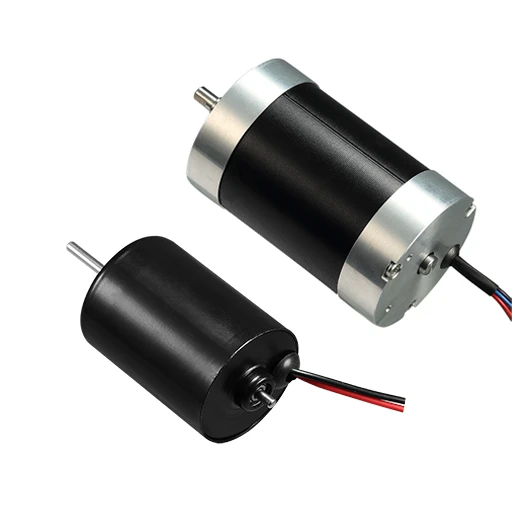
In an outrunner, the magnet-bearing outer shell rotates around an internal stator. The larger working radius supports useful torque density and often allows direct propeller drive. An inrunner places the rotor inside the stator and is common where higher shaft speed, lower rotor inertia, a compact rotating envelope or a gearbox is preferred. Outer rotors generally have more inertia than comparable inner rotors, so it is inaccurate to define every drone motor as a "low-inertia outrunner."[2]
| Outrunner tendency | Inrunner tendency |
|---|---|
| Large rotor radius and direct-propeller packaging | Rotor turns inside the stator |
| Common across multirotor propulsion | Lower rotating radius can reduce rotor inertia |
| Rotating bell requires balance and clearance | Often paired with a gearbox or high-speed load |
| Cooling path must be validated in the installation | Also used in aerospace and other compact drive systems |
What KV means — and what it does not tell you
KV is the motor speed constant, normally expressed in rpm/V. It relates back EMF to speed and gives a first estimate of ideal no-load speed. It is not kilovolts, a power rating, an efficiency score or a guarantee of loaded RPM. Once a propeller draws torque, winding resistance, controller voltage drop and other losses reduce actual speed.
Ideal no-load rpm ≈ KV × voltage. A 2300 KV motor at 16.8 V gives about 38,640 rpm as a theoretical no-load estimate — not an expected propeller speed.
Kt ≈ 60 ÷ (2π × KV) [Kt in N·m/A; KV in rpm/V]. Within a comparable motor family and consistent constant definitions, higher KV corresponds to lower torque per amp. Maximum torque still depends on current, saturation and thermal limits.
Motor constants are also used outside drones. Industrial permanent-magnet motors and servos have back-EMF and torque constants even when the catalog emphasizes rated speed and torque. EURARI's technical parameter guide distinguishes no-load speed, stall torque, back-EMF constant, torque constant and speed constant — useful evidence that one number cannot represent the whole motor.[3]
No universal "drone KV range" exists. Two official examples show why no universal range is defensible: a 35 KV T-Motor A16-24S agricultural propulsion system and a 2824 rpm/V DJI Mini 3 Pro motor. These are examples, not market endpoints. Voltage, propeller diameter, aircraft mass and mission explain the difference; the larger KV number is not inherently superior.[4]
Thrust comes from a tested combination, not the motor alone
A motor does not have one fixed thrust value. Static thrust changes with propeller diameter, pitch, blade count, voltage, air density, ESC settings and test conditions. Motor mass alone also says little. The defensible way to cite thrust is to name the exact setup and label electrical input separately from mechanical output.
One verified 2207 operating point — not a universal 2207 specification
The P2207 V2 KV1950 test table published by distributor LIGPOWER, for a T5143S propeller on 6S, reports the following 100% throttle operating point at an 8 °C ambient temperature. It demonstrates one matched bench setup; it does not describe every 2207 motor or every propeller.[5]
| Verified test condition | Published value |
|---|---|
| Motor | P2207 V2 KV1950; motor mass 33.7 g including cable |
| Propeller and supply | T5143S; 6S; measured bus voltage 23.1 V |
| Test point | 100% throttle; ambient temperature 8 °C |
| Static thrust | 1,378.61 g — approximately 1,379 gf or 13.52 N |
| Current and speed | 32.73 A; 31,291 rpm |
| Electrical input | 755.89 W published; 23.1 V × 32.73 A ≈ 756.1 W using rounded fields |
| Reported thrust efficiency | 1.82 g/W at this test point |
External benchmark: published static test data for the named P2207 V2 KV1950 + T5143S + 6S combination. The complete source table is linked in reference [5]; source checked 29 July 2026.
Thrust-to-weight is a margin question, not a universal 2:1 rule
In steady level hover, total vertical thrust balances aircraft weight. Extra available thrust supplies climb, acceleration, attitude control and margin for wind, altitude, battery sag and uncertainty. A 2:1 maximum-thrust-to-weight ratio is a common hobby target, but it is not a physical threshold for stable flight and should not be written as a requirement. Aircraft configuration, control authority, mission and applicable safety process determine the needed margin.[6]
Thover ≈ m × g ÷ N [newtons]. This simple balance is a starting point for a symmetric multirotor in calm, level hover — not a complete sizing rule.
Design thrust = hover need + mission margin. Validate the margin against manufacturer data, air density, battery condition, thermal state and control requirements.
Why an industrial AC motor is rated differently
A line-fed induction motor is designed around supply frequency, pole count, load and thermal duty. Its synchronous speed is 120 × frequency (Hz) ÷ total pole count [rpm]; actual rotor speed is slightly lower because induction requires slip. A variable-frequency drive changes frequency and voltage to provide adjustable speed. It is therefore too broad to say that every AC motor is "locked to 50 or 60 Hz" or cannot respond quickly.[7]
Industrial catalogs emphasize rated shaft power, torque, speed, efficiency, duty class, enclosure and insulation because those describe the intended load. Drone propulsion catalogs emphasize KV, mass and propeller test tables because those help builders match a flight system. Both sets of data are valid in context; neither proves that one motor is fundamentally stronger or more advanced.
- Choose a propulsion-style BLDC system when mass, propeller thrust, rapid control response and airborne packaging dominate, and you can validate a matched motor-ESC-propeller setup.
- Choose another motor architecture when continuous shaft torque, a gearbox, mains power, sealed construction, low-speed positioning or a defined industrial duty is the real requirement.
Drone motors are not simply "burst motors," and no-load testing is not the main thermal case
A multirotor motor continuously produces thrust in hover. Higher current may be permitted for shorter durations, but the actual limit depends on winding temperature, ambient temperature, rotor speed, airflow, installation, controller settings and the manufacturer's test method. Some published UAS motor ratings explicitly state both a time limit and a minimum airflow condition, which is why duration and cooling belong beside every headline power number.[8]
The common claim that an unloaded motor "reaches 100 °C within a minute because no propeller means no airflow" is not a safe generalization. With no propeller, load torque and copper current are usually much lower, although high-speed iron, bearing and windage losses remain. The more relevant overheating risk is a loaded static-thrust run or oversize propeller without the cooling and duration used to qualify the rating.
| Thermal question | What to verify | Why it matters |
|---|---|---|
| Current rating | Continuous or time-limited? At what speed and airflow? | Copper loss rises approximately with current squared. |
| Power figure | Electrical input or mechanical output? For how many seconds? | Input power includes losses and cannot be compared directly with shaft output. |
| Cooling | Propwash, freestream, forced air, conduction path or enclosed installation? | The same motor can have very different temperature rise in a different airflow path. |
| Temperature limit | Winding, magnet, bearing, adhesive and ESC limits. | Irreversible magnet weakening can begin below a material's Curie temperature. |
| Duty profile | Hover, climb, transient maneuver, endurance cruise or bench test. | Average and peak loss determine heat accumulation differently. |
Sanity-check catalog data: use relationships such as P = V × I for DC-bus electrical input and compare related fields before publishing or purchasing. If voltage, current and power conflict by orders of magnitude, request a corrected data sheet instead of guessing which field is right.
How to choose a drone propulsion motor without relying on one headline number
Treat the propulsion unit as a system and move through the requirements in order. This prevents the common mistake of buying a high-KV motor first and trying to make the battery and propeller fit later.
- Define the aircraft and mission: record all-up mass, motor count, endurance, altitude, ambient temperature, climb and maneuver requirements, acoustic constraints and installation envelope.
- Set hover need and control margin: calculate thrust per motor at hover, then add a justified margin for the mission instead of applying a universal ratio.
- Choose a propeller family and bus voltage: frame clearance, tip speed, noise, air density and battery architecture narrow the useful diameter, pitch and voltage range.
- Shortlist matched motor-propeller data: use the manufacturer's exact test table. Compare thrust, current, input power, speed, efficiency metric and temperature under equivalent conditions.
- Size the ESC and electrical path: confirm voltage, current margin, maximum electrical speed (mechanical rpm × pole pairs), motor and propeller speed limits, commutation/timing guidance, wire and connector limits, telemetry, protection behavior and battery capability.
- Validate the real installation: measure thrust, current, vibration and temperature with the actual mount, airflow and duty profile. Recheck after propeller, firmware or battery changes.
Can a drone motor replace a regular motor?
Sometimes, but only if its speed-torque curve, controller, gearing, cooling and duty fit the new load. A high-speed propulsion motor may need substantial reduction to drive a wheel or conveyor. A purpose-built gearmotor can be smaller and simpler at the output shaft even when the bare drone motor looks lighter. Conversely, a heavy industrial motor may be unsuitable for flight despite excellent continuous torque.
That replacement question becomes clearer when propulsion is separated from the other actuators carried by an aircraft. "Brushless" alone cannot tell you whether a motor is intended for propeller thrust, smooth position control, a geared latch or a compact pump.
Beyond propulsion: the other motors on a drone
Propulsion is only one motion function onboard an aircraft. Cameras, lenses, latches, pumps and sensor turrets often need much smaller motors with different torque-speed, precision, vibration and duty priorities. Those non-propulsion jobs are the UAV applications most directly aligned with EURARI's compact motor and gearmotor portfolio.
Application map for compact UAV actuators
| UAV subsystem | Practical motor starting point | Selection checks that matter |
|---|---|---|
| Camera gimbal | Low-cogging BLDC or gimbal motor | Smooth low-speed torque, torque ripple, position feedback, balance and vibration |
| Lens focus or zoom | Coreless brushed DC or miniature BLDC, optionally geared | Package size, acoustic noise, current, backlash and positioning resolution |
| Payload release or latch | Compact planetary/spur gearmotor or actuator | Peak and holding torque, shock load, fail-safe state, duty cycle and self-locking |
| Agricultural spray pump | Brushed DC or BLDC matched to the pump | Flow and pressure curve, liquid compatibility, sealing, continuous duty and cooling |
| Sensor or obstacle-avoidance turret | Miniature BLDC or gearmotor with feedback | Backlash, encoder resolution, low-speed control, cable routing and vibration |
Qualification boundary: these are subsystem starting points, not propulsion recommendations or flight-qualified product claims. Final selection requires the load curve, voltage, duty cycle, environment, controller, mass/space and validation requirements.
Relevant EURARI starting points
- Lightweight brushless motion: ECL0815006 Ø8 mm coreless BLDC motor — a compact platform to evaluate against the actual subsystem load.
- Compact geared output: PG16-EC1636012 Ø16 mm planetary BLDC gearmotor — a starting point where reduction and output torque matter more than propeller speed.
- Simple miniature actuation: DC1230003 Ø12 mm brushed DC motor — a reference platform for compact, cost-sensitive mechanisms.
- Engineering brief: use the EURARI motor selection guide before requesting a custom winding, gearbox or controller.
Before a motor or actuator test
A propeller can produce dangerous force with little warning. PX4's actuator setup guidance explicitly warns users to remove propellers before motor assignment and testing.[9]
- Remove propellers for output assignment, direction checks and initial ESC setup.
- Secure the test article and keep people, loose items and cables clear of rotating parts.
- Inspect propellers, adapters, fasteners and motor bearings before any loaded run.
- Use current limiting, appropriate protection and a controlled stop method.
- Do not block required ventilation; stop if vibration, odor or temperature rises abnormally.
- Allow hot motors and ESCs to cool before handling or repeating the test.
Related EURARI motor resources
- Explore EURARI brushless DC motors — review compact BLDC platforms and customization options.
- Read the coreless and ironless motor data guide — compare low-inertia construction and parameter terminology.
- Review motor control and PWM fundamentals — continue with commutation, drivers and control basics.
- Use the EURARI motor selection guide — translate load, voltage, speed, torque, duty and environment into a motor brief.
- Static pressure versus airflow — clarify two related but different aerodynamic quantities before evaluating a fan, blower or propeller-driven application.
Frequently asked questions about drone motors vs regular motors
Are all drone motors brushless outrunners?
No. Brushless outrunners are common in modern multirotors, but small toy aircraft may use brushed motors and other UAV architectures may use inrunners, geared motors or integrated propulsion units. Choose by mission and verified system data.
Do drone motors run on DC or AC?
The aircraft battery supplies DC to an ESC/inverter. The ESC electronically commutates phase currents in the permanent-magnet motor, so describing the motor simply as "DC" or "AC" can hide the important role of the inverter.
Does higher KV mean a more powerful drone motor?
No. KV is a speed constant in rpm/V. Within a comparable motor family, higher KV generally means lower torque per amp. Maximum power and torque also depend on current, voltage, magnetic design, cooling and duration.
Is a 2:1 thrust-to-weight ratio required for stable flight?
No. Level hover requires total vertical thrust equal to weight. Additional thrust provides mission and control margin. A 2:1 ratio is a common hobby target, not a universal physical or regulatory requirement.
What does a size code such as 2207 mean?
In the common FPV convention, 2207 usually means an approximately 22 mm stator diameter and 7 mm stator height. It is not a universal standard, so verify the manufacturer's mechanical drawing and stated mass.
Can I choose a drone motor from KV and wattage alone?
No. Select the motor, propeller, battery voltage and ESC as a system. Use the exact test table, confirm time and airflow conditions, and validate thrust, current, temperature and vibration in the real installation.
References and test data
- NASA — Electronic Speed Controller Degradation and Failure Study, for the DC-bus inverter and synchronous-machine description.
- NASA — An Initial Electric Motor Rotor Vibration Model, plus Portescap — Inner or Outer Rotor Position Specification.
- maxon — Motor constants, and EURARI — Guide to DC Motor Technical Parameters.
- T-Motor — A16-24S KV35 propulsion system, and DJI — Mini 3 Pro specifications, as examples of mission-dependent KV.
- LIGPOWER — P2207 V2 complete test table, and T-HOBBY — current Pacer P2207 V2 product page, for the named KV1950 + T5143S + 6S bench point.
- NASA — Fundamental Proprotor Design Considerations, for thrust and aircraft-weight fundamentals.
- U.S. Department of Energy — Improving Motor and Drive System Performance, for induction-motor speed, slip and variable-frequency drives.
- maxon — Continuous operation range of BLDC motors, and KDE Direct — airflow-qualified UAS motor ratings.
- PX4 v1.17 Stable — Actuator Configuration and Testing, including the propeller-removal warning.
Need a compact motor for a UAV subsystem?
EURARI develops customizable brushless DC motors, brushed DC motors, ultra-high-speed motor and blower platforms, gearmotors and gearboxes. In this guide, the most relevant fit is compact motion for non-propulsion UAV subsystems; lift propulsion should be selected from qualified propulsion-system data.
For an engineering review, share the subsystem load or torque curve, target speed, bus voltage, duty profile, ambient conditions, controller or feedback needs, installation envelope, mass limit and validation requirements.
Next step: contact EURARI to discuss the application.
Product examples and cited operating points are snapshots of manufacturer-published conditions, not universal limits or endorsements. Confirm the exact product revision and current data sheet before design release.
