


Is It Static Pressure or Airflow That Moves Air?
Airflow and static pressure are not the same thing, and a blower picked on one when the job needed the other is a common reason a compact product tests well on the bench and disappoints in the field. Airflow, in CFM or m³/min, is the volume of air moved at a stated condition; the headline maximum is usually taken near free-air, with little in the way. Static pressure, in pascals or inches of water, is the push a blower still has once resistance builds. Vacuums, hair dryers, air pumps, and air knives all force air through filters, nozzles, and ducts. They need push, not just volume. So the figure that decides the outcome is neither peak CFM nor peak pressure. It is the point where the blower's pressure-flow (P-Q) curve crosses the resistance of your system. EURARI's high-speed brushless blowers run up to 130,000 rpm for exactly these pressure-limited jobs.
Where Does a Blower Actually Run?
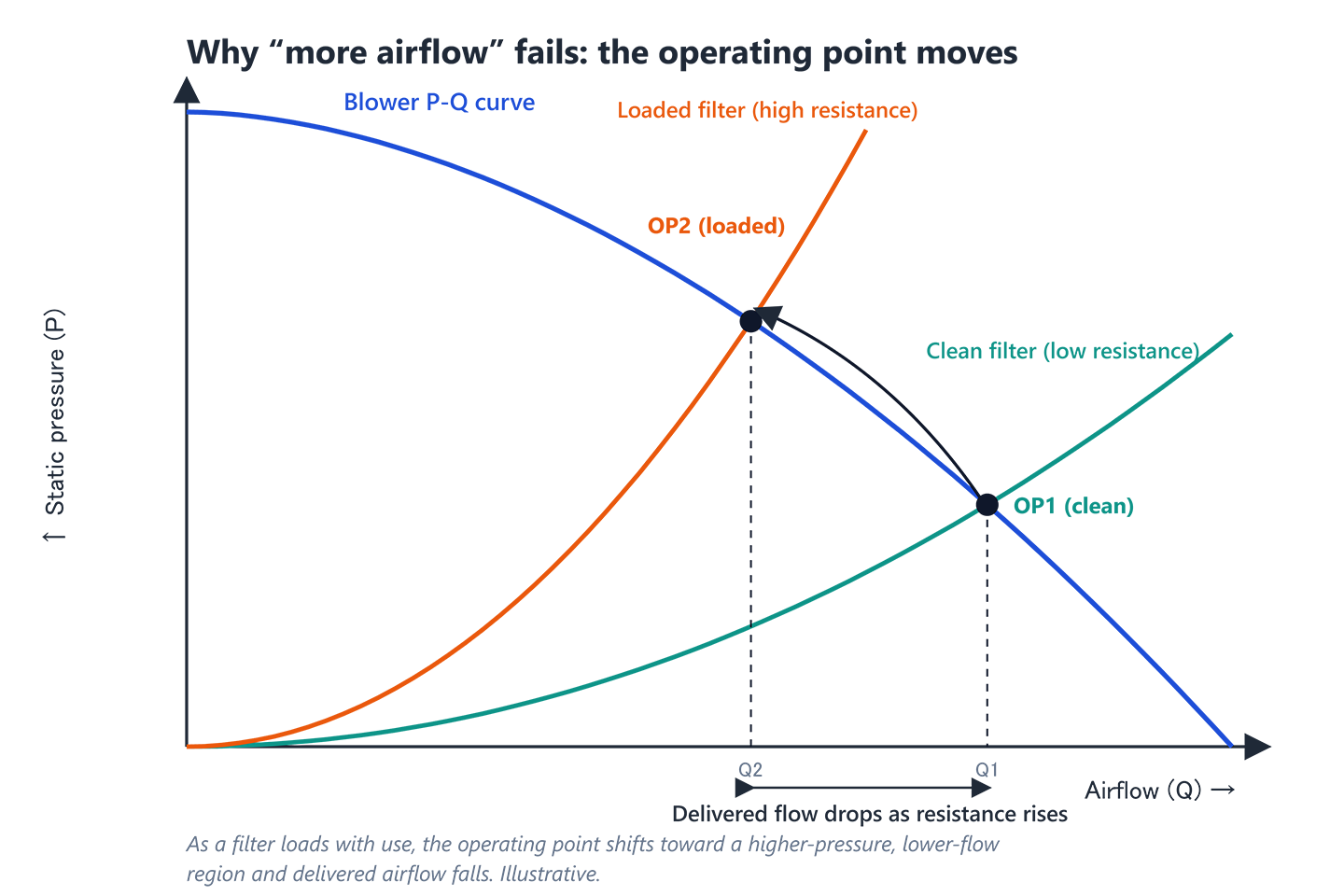
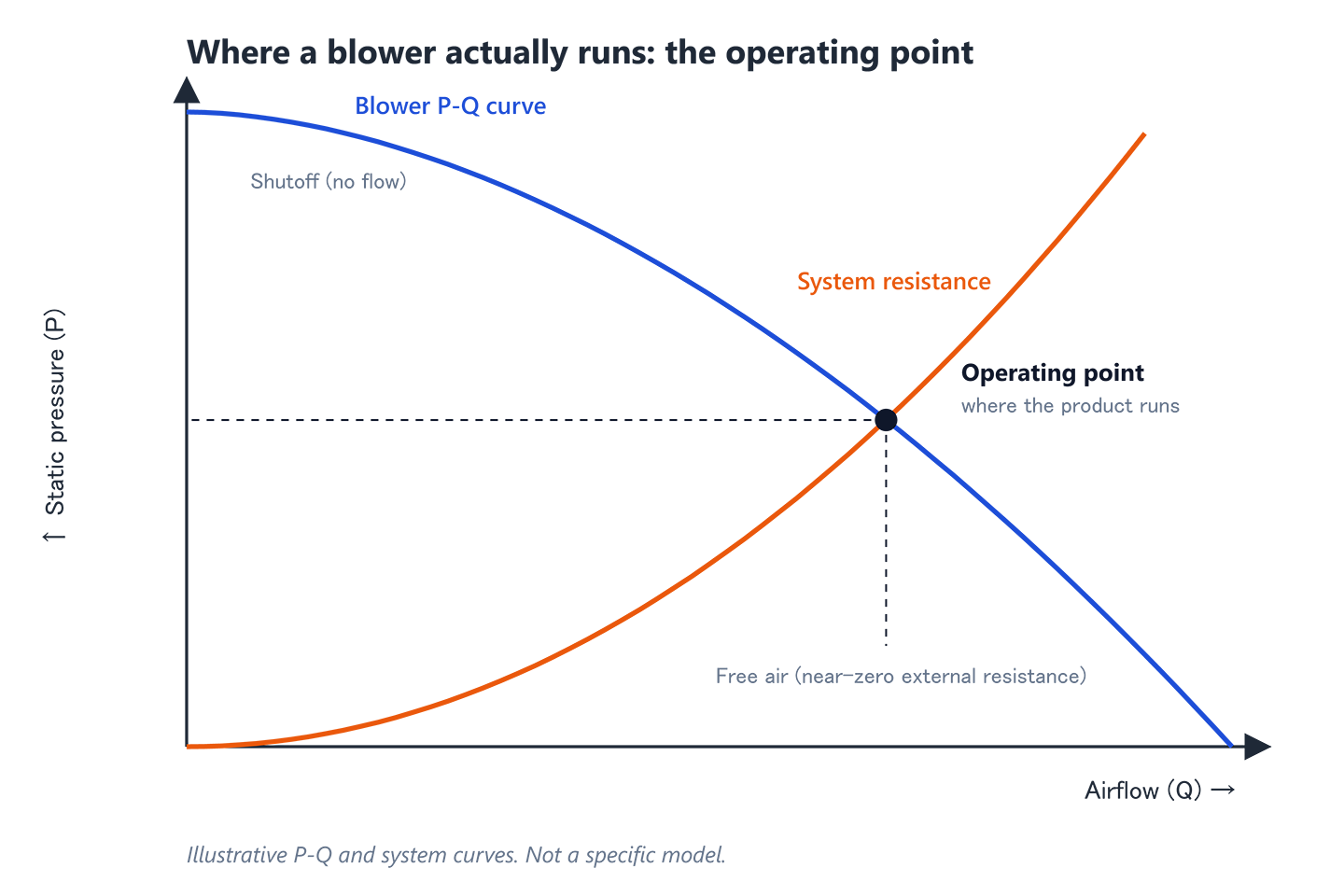
Two curves decide how a blower behaves inside a product. One is the device's own resistance, which climbs as flow climbs, because every filter, bend, and nozzle fights the air. The other is the blower's pressure-flow (P-Q) curve, running the opposite way: high pressure at zero flow, high flow when external resistance is near zero. Where the two lines cross is the operating point. Change the speed or the resistance and it moves; hold them steady and that is where the product runs.
This is where a headline CFM number misleads you. It's almost always a free-air figure, taken with the outlet wide open and nothing in the way. Add a loaded filter and the operating point slides along the curve toward higher pressure and lower flow, and the flow you actually get can be a fraction of the headline rating. A cordless stick vacuum makes the point. Chosen on peak free-air CFM, it reads well on the bench. Put it in a real hallway, pulling fine dust through a packed filter, and the operating point lands in a high-resistance region the blower was never sized for. The head stops lifting hair off the carpet. Nothing about the CFM figure was false. It was just measured somewhere the product never runs.
What Does a P-Q Curve Tell You?
The aerodynamic behaviour of a blower lives in one graph, the P-Q curve, and no single peak number tells it. The curve has two ends. At one, external resistance is near zero and the blower moves its most air, going nowhere in particular. At the other, the outlet is blocked: flow drops to zero and all the blower does is hold pressure. Real products operate between those two ends, on the sloping middle of the curve.
The shape of that middle is what fit comes down to. One impeller may bleed pressure fast as flow rises; another holds it deeper into the working range. You cannot read that off a peak value, which is the whole reason to ask for the curve. Those curves come from lab tests run to fixed methods like ANSI/AMCA Standard 210 (now the 210-25 edition), so a curve on a spec sheet carries weight a marketing headline does not. With only one peak number, neither of you can say where the device will actually run on the curve.
Which Pressure Actually Matters?
“Pressure” on a fan sheet can mean more than one thing, and the three are not interchangeable. Static pressure is the part that goes toward overcoming system resistance. Velocity pressure belongs to the moving air itself. Total pressure is the two added together, under whatever measurement convention the sheet uses. Which one you match against depends on the test setup and where the system boundary is drawn, so a velocity figure and the system impedance have to be read side by side. Fast air at the outlet does not, by itself, mean the blower will hold your flow once the system pushes back.
Fan or Blower, Axial or Centrifugal?
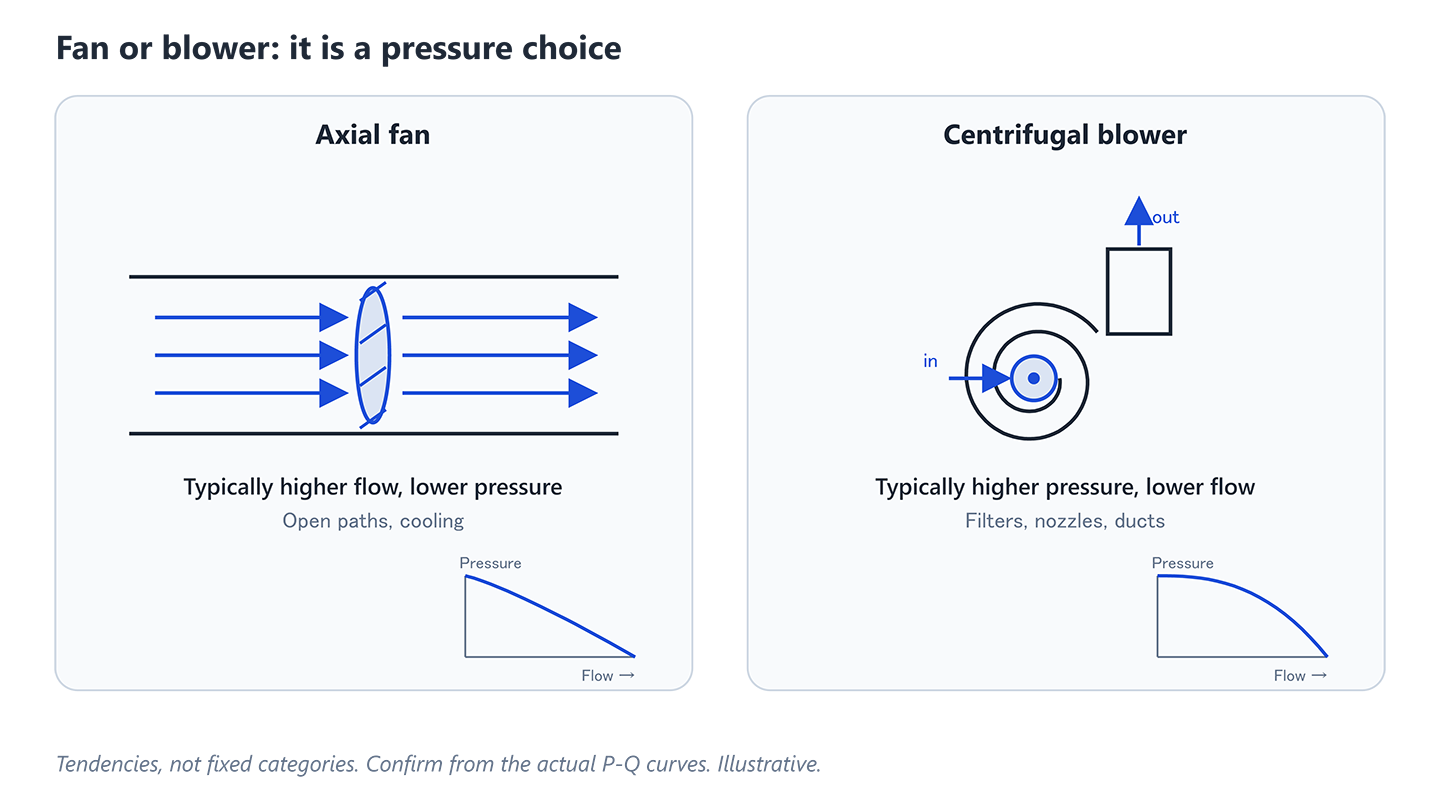
Underneath, choosing between a fan and a blower is choosing how much pressure you need, and the labels are looser than they sound. An axial fan suits an open path: plenty of flow, not much resistance to fight, the kind of job cooling asks for. A centrifugal blower earns its keep once the air has to get through filters, tight passages, nozzles, or ducting. The edges blur, though. Big centrifugal fans move plenty of air, and some axial and mixed-flow designs build real pressure, so two products only sort themselves out on their P-Q curves, never on a rule-of-thumb ratio.
Hair dryers, handheld vacuums, air knives: anything that pushes air through real resistance usually calls for a high-static-pressure blower rather than an open fan, and the impeller and the speed of a purpose-built brushless DC or coreless motor settle how well it does. Line the two candidates up at the flow your device needs, and compare the pressure each still holds there.
How Do You Read a Blower Spec Sheet?
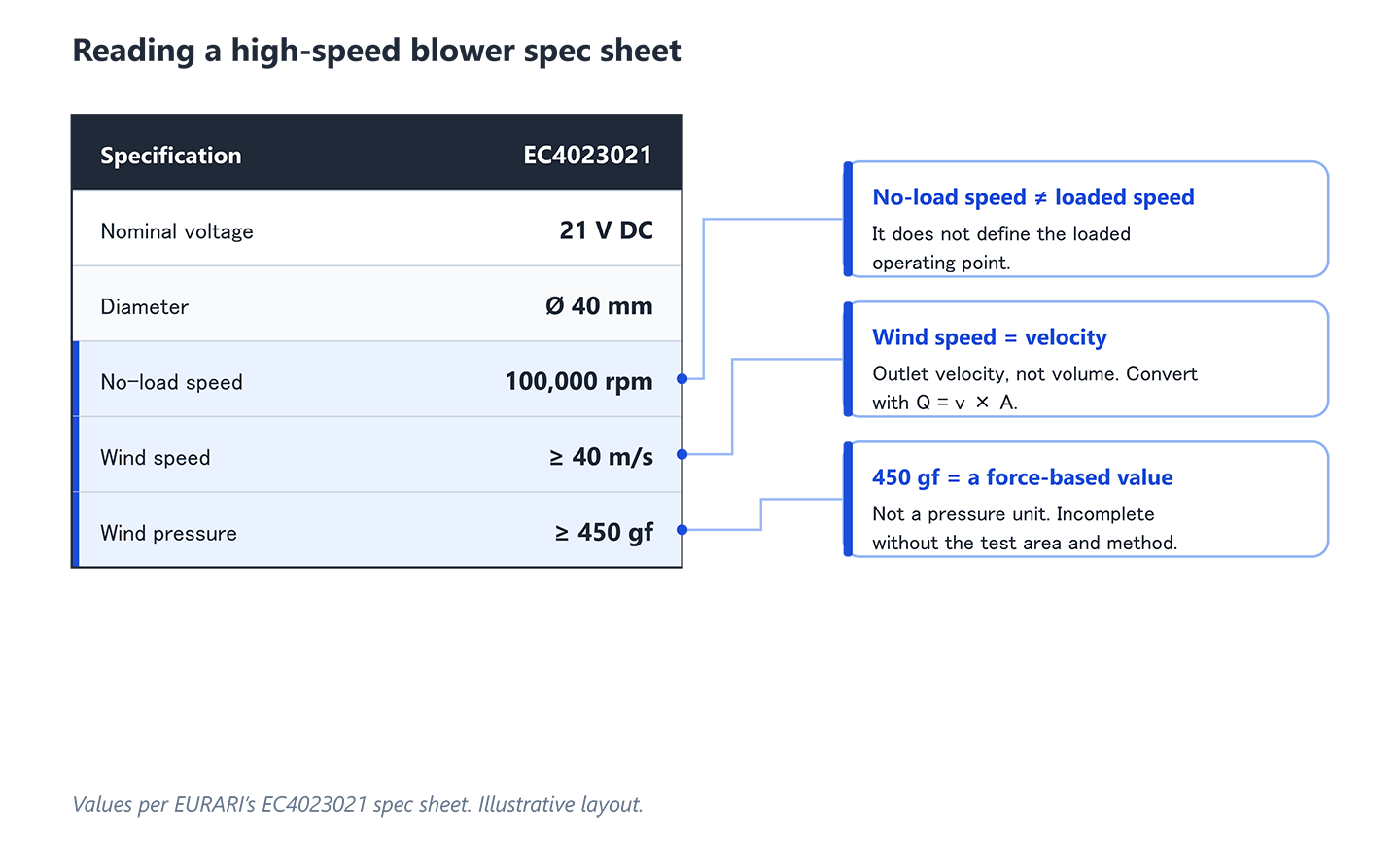
Not every spec sheet uses the same conventions, so read each line for what it measures, not for how big the number looks. Take one of EURARI's Ø40 mm high-speed blowers. Its sheet gives a wind speed of at least 40 m/s, a wind pressure of at least 450 gf, and a no-load speed of 100,000 rpm. Three numbers, three different things.
Wind speed in m/s is outlet velocity, not volume. It tells you how fast air leaves the port, nothing about how much of it. Two blowers can read the same 40 m/s and move very different amounts of air, because that depends on the outlet area. So convert before you compare. Flow Q is velocity v times outlet area A. Run it for a typical outlet, say 20 mm across (the outlet bore, not the Ø40 mm motor body), at an assumed average 40 m/s, and you get about 0.0126 m³/s, call it 0.75 m³/min, before the velocity profile and test losses eat into it. Treat that as a back-of-envelope figure, not a stand-in for a measured curve.
Wind pressure in grams-force is the field to slow down on, because grams-force is a unit of force, not pressure. Pressure is force over area. Without the fixture, the reference area, and the method behind that 450 gf, there is no honest way to turn it into pascals or inches of water, and it is not a full static-pressure spec on its own. The “≥” only promises the result will not come in under that figure on the supplier's own test. It says nothing about the condition: shutoff, free discharge, something in between. Ask. No-load speed, up to 130,000 rpm on EURARI's top blower, shows what the impeller can reach unloaded and little about where it settles under load. Each of these can be a perfectly good measurement and still leave the one thing you need undefined, which is the loaded operating point. Design to that point, not to a corner of the curve.
What Does a Supplier Need to Size a Blower?
Sizing to a device instead of to a catalog corner comes down to a handful of parameters. Have them ready and a vague enquiry turns into a real engineering answer instead of a back-and-forth. The table below is what to send. Early in a design, some of it will be unknown, and that is fine: application, outlet, a target airflow, voltage, and the size you have to fit are usually enough to open a serious conversation. Nailing the final part often needs test or system-resistance data on top.
| Parameter | what to provide |
|---|---|
| Required airflow | CFM, L/min, or m³/min at the actual operating point |
| System resistance | Pa or kPa at the target airflow |
| Outlet geometry | Diameter, area, and nozzle shape |
| Electrical input | Rated voltage and allowable current |
| Duty cycle | Continuous, intermittent, or pulsed |
| Size envelope | Maximum diameter and length |
| Noise target | dBA and measurement distance |
| Application | Vacuum, dryer, cooling, inflation, air knife |
| Service life | Expected operating hours |
| Volume | Prototype and annual production quantity |
Spec'ing to your device, in order
Do it in order. Start with the system, not the blower: measure or estimate the resistance the device puts up across the flow range you care about, filter, ducting, outlet and all. Then lay a candidate blower's P-Q curve over that system curve and read off where they meet, and check the flow and pressure there against what the product actually needs. Last, build in margin, because a filter clogs over its life and the operating point creeps up the curve as it does.
Off the shelf, you take the curves that exist and match to them. On a custom program the range opens up: depending on what the project needs, EURARI can work from an existing blower platform or look at changes to the motor, impeller, driver, and control. How far that customization goes comes down to the operating target, the tooling involved, how it has to be validated, and the volume behind it.
Two ways to start
Already have a target operating point? Send the required airflow, back-pressure, voltage, size limit, and duty cycle, and EURARI's engineers can check it against a stock blower or scope a custom one.
No system curve yet? Send the application, the filter or nozzle setup, a target airflow, the size you have to fit, and whatever blower you are running now. That is enough for the team to mark out a first selection range.
Send your operating requirements and talk to our engineers about airflow, pressure, voltage, size, and whether a custom build is worth it for your application.
FAQ
Is static pressure or airflow more important?
Neither, on its own. The operating point decides it, where your resistance meets the blower's curve. Open cooling is flow-led; anything through a filter, duct, or nozzle is pressure-led. Read both against your own system curve instead of chasing the bigger number.
What is the difference between a fan and a blower?
As a tendency: axial fans for higher flow at low pressure, centrifugal blowers when the air has to fight through filters, nozzles, or ducts. They are tendencies, not hard categories, so settle any real comparison on the two P-Q curves, not a rule of thumb.
A blower is rated at 40 m/s wind speed. How much airflow is that?
By itself, you can't say. That 40 m/s is outlet velocity, not flow. Multiply it by the outlet area for a rough number, but the true figure moves with the velocity profile and the test setup, so ask for the flow value and the full curve before you compare.
Does higher RPM always mean more airflow?
Not on its own. Within one design and at roughly constant air density, the affinity laws say flow tracks speed and pressure tracks speed squared. Those hold inside a single design; they are not a way to rank unrelated blowers by RPM.
