


Why Organizations Lose Touch with Reality: Metric Substitution, Consensus Bias, and Cognitive Decay
In many organizations of scale, three things can be observed at the same time: the numbers in the reports look better every year; meetings produce less disagreement every year; execution grows more polished every year. Meanwhile, the product is getting worse, customers are leaving, and the real problems are becoming harder and harder to say out loud.
These three phenomena are usually explained separately: the first gets blamed on misaligned KPIs, the second on a management style turned conservative, the third on people who simply aren't good enough. Put them side by side, however, and they turn out to be not three diseases but one disease showing up in three different organs. That disease has a name: the degradation of the organization's reality-feedback channel. And it unfolds in a definite order: first the information layer fails, then the incentive layer locks the failure in place, and finally the cognitive layer strips the organization of its ability to correct itself. What follows traces that sequence.
1. The Starting Point: Compression Is Inevitable — Distortion Is Not
Reality is high-dimensional. Whether a product is good depends simultaneously on how users actually feel, the contexts of use, long-term trust, stability, performance, the competitive landscape, and technical debt — factors that entangle with one another and that no single person can take in at a glance. Management, on the other hand, requires reporting, comparison, decision-making, and appraisal, which means compressing that high-dimensional reality into a handful of transmissible signals: user satisfaction becomes a score, product quality becomes a few metrics, business health becomes a growth curve.
There is no original sin in this step. Cybernetics established long ago that a regulator's internal representation must match the complexity of its environment (Ashby's Law of Requisite Variety); James C. Scott, in Seeing Like a State, called this governance-driven simplification "legibility" and showed it to be the fate of every large organization. Metrics are the sensors through which an organization perceives reality; without sensors, no organization can operate at scale.
The problem is that compression can go in two directions. One is effective abstraction: keep the essential structure, discard the noise. The other is informational distortion: delete the difficult parts and keep only what is easy to express. Organizations almost always drift slowly toward the second, for a mundane reason — complicated problems mean more explaining, more responsibility, more resource requests, and more uncertainty, whereas a good-looking metric needs only one slide, one number, one trend line. Simple narratives are cheaper to transmit and politically cheaper to carry. That slope never goes away.
2. The First Degradation: The Proxy Replaces the Goal
The moment a metric turns from a sensor into an appraisal target, the system being measured begins to adapt to the measurement. This is Goodhart's Law: when a measure becomes a target, it ceases to be a good measure. Campbell's Law, from the social sciences, says the same thing: the more heavily a quantitative indicator is used for decision-making, the greater the corruption pressure it comes under.
Concretely: appraise speed, and teams optimize speed; appraise volume, and teams inflate volume; appraise completion rates, and teams raise completion rates. Whether the speed created any value, whether the volume meant anything, whether "completed" actually solved the problem — these questions gradually lose their audience. A healthy organization runs the loop "real problem → build understanding → act → reality improves → feedback confirms." The degraded loop becomes "set a goal → find a presentable metric → optimize the metric's appearance → package it into a report → win approval" — and what is missing is precisely the one step that matters: did reality actually improve? The organization thereby grows a new capability: not the capability to solve problems, but the capability to explain that problems have been solved.
Up to this point, the damage is still reversible. As long as someone can point out that the numbers look good while reality is getting worse, the system has a chance to recalibrate. What makes the degradation irreversible is the second mechanism.
3. The Second Degradation: Incentive Lock-In — Why Nobody Corrects It
If people inside the organization can plainly see the distortion, why does nobody correct it? The answer lies in the structure of evaluation.
What managers can directly observe is never reality itself, but the behavior of the organization's members. Easy to evaluate: whether things were delivered on time, whether processes were followed, whether requests were answered, whether the person stayed aligned with the whole. Genuinely important but hard to evaluate: whether someone uncovered a hidden problem, raised the right objection, or prevented a major future loss. The first kind of behavior pays off immediately, visibly, and attributably; the second pays off late, invisibly, and unattributably — an accident that was prevented never appears in any report.
Evaluation therefore tilts naturally toward conformity. Not because conformity is more correct, but because it is easier to manage. Meanwhile, the costs of correction are immediate and local: someone has to re-analyze, re-decide, revise plans, and take responsibility, and every correction produces local instability. No organization opposes error-correction in writing; it simply keeps raising the friction around it. Over time, members internalize an unwritten rule: staying stable matters more than being right, and bringing simple answers is safer than bringing complicated reality.
This is the classic imbalance between exploration and exploitation in organizational learning (James March): exploration pays off far in the future and uncertainly, exploitation pays off soon and reliably, and any system not deliberately designed against the drift will slide toward the latter. It also produces a by-product: when reality diverges from expectations, admitting that the internal model is wrong requires revising the whole organization's understanding, whereas blaming "market shifts, fierce competition, insufficient resources" requires only revising the explanation. Explanations are always cheaper than cognition, so failure gets systematically externalized and the internal model grows ever more immune to challenge.
The function of this second degradation is to lock in the first: distortion is no longer an occasional accident, but an equilibrium continuously rewarded by the incentive structure.
4. The Third Degradation: The Shrinking Supply of Understanding
The first two degradations explain why the organization does not want to correct itself; the third explains why, eventually, it cannot.
A popular explanation attributes metric-gaming and box-ticking to low cognitive ability at the execution level. It does not hold up: most people who game metrics are not short on cognition — they are responding rationally to their incentives. The real mechanism is colder: cognitive decay is not a property of individuals; it is an output of the system.
Understanding a full causal chain — metric movement → user experience → product value → long-term competitiveness — requires two things: raw information that crosses hierarchy levels, and the license to experiment and to question. Those are exactly what the first two degradations cut off: distorted compression at the information layer keeps raw context from traveling across levels, and consensus bias at the incentive layer makes questioning expensive. Stay long enough in such an environment, and a node's world-model gets trained into its most economical shape: "metric down → find a way to push the metric up." It is not that the person cannot understand the system; it is that the organization neither supplies the inputs such understanding requires nor rewards the act of understanding.
Then comes the most dangerous closing of the loop: as more and more nodes can only operate on metrics, metrics become the only language that still travels across levels, and the organization is forced into even deeper dependence on them — which in turn worsens the compression distortion at the information layer. Rules try to compensate (misconduct discovered: add approvals; fabrication discovered: add audits; communication broken: add meetings), but rules can only transmit information; they cannot create understanding. The rulebook thickens, the system grows heavier, and in the end everyone is maintaining the process while no one remembers the goal.
5. The Coupling: A Self-Reinforcing Loop
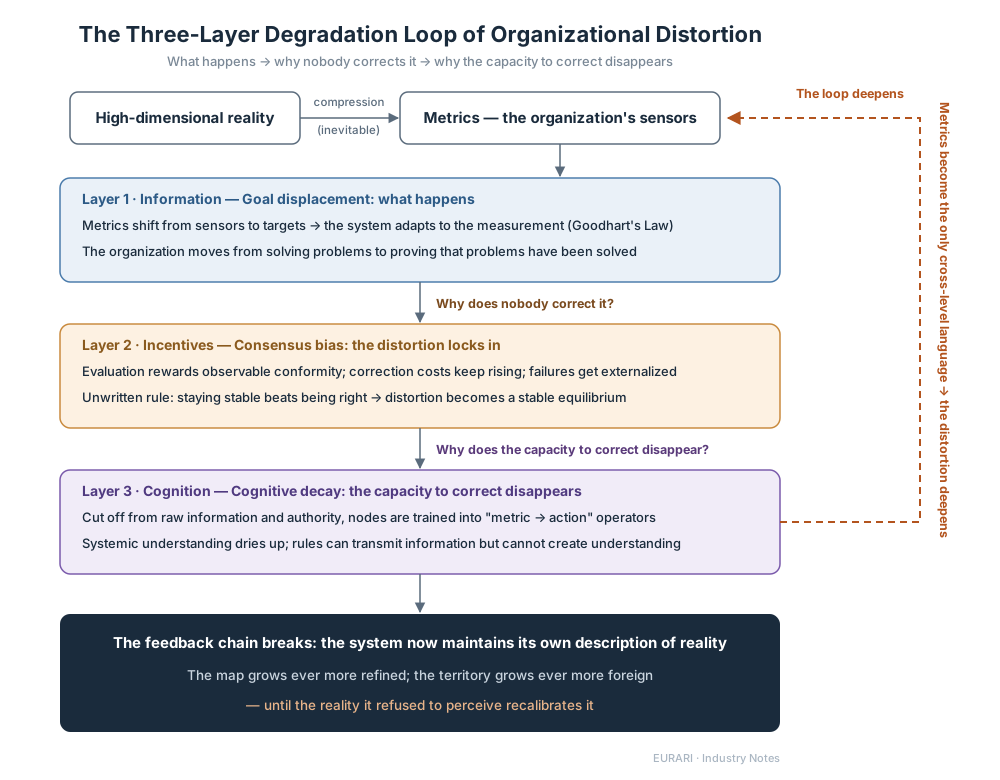
Put the three mechanisms together and a complete dynamical structure appears; each answers a successive question.
The information layer answers "what happens": high-dimensional reality must be compressed into metrics; under appraisal pressure the metric is alienated from sensor into target, and feedback starts pointing at a substitute for reality. The incentive layer answers "why nobody corrects it": evaluation favors observable conformity, raises the cost of correction, and externalizes failure, locking the distortion in as a stable equilibrium. The cognitive layer answers "why the capacity to correct eventually disappears": the environment shaped by the first two layers trains nodes into metric-operators, the supply of whole-system understanding shrinks, and the organization is pushed into deeper metric dependence — back to the information layer, one turn deeper into the loop.
This is not a straight line but a self-reinforcing loop: compression produces metrics → metrics shape incentives → incentives reward conformity and punish correction → nodes learn to operate only on metrics → metrics become the organization's only language → compression distorts further. With every turn, the map grows more refined and the territory grows more foreign. The loop's endpoint is a system that no longer maintains reality but maintains its own description of reality — until, one day, the real world it refused to perceive recalibrates it, in the form of lost orders, customer complaints, or a crisis.
6. The Dividing Line: Reality-Adapting Systems vs. Self-Maintaining Systems
It must be stressed that excellent organizations are not organizations without metrics, without alignment, without process — quite the opposite: they usually use more of all three. The dividing line is not the tools, but what the tools point at.
An excellent organization treats metrics as an entry point for discovering problems; a declining organization treats metrics as an instrument for proving there are none. The former asks, "what is the reality behind this number?"; the latter asks, "how do we make this number look better?" An excellent organization puts alignment in the service of correction — shared language and cadence exist so that real feedback enters the system faster; a declining organization lets alignment substitute for correction — unity becomes the goal itself. An excellent organization uses rules to supplement understanding; a declining one uses rules to replace it.
In the short run, self-maintaining systems are almost always the more stable — that is exactly their seduction. In the long run, a system that refuses to perceive the real world will be recalibrated by it, and the later the recalibration comes, the higher its price.
7. A Footnote from Manufacturing
Take manufacturing, the industry we know best: this loop is anything but abstract. A factory's outgoing pass rate can stay impressive for years while its complaint rate quietly climbs — because the pass rate measures conformity to an inspection standard at the moment of shipment, whereas what the customer experiences is bearing wear and parameter drift three thousand hours later. Both are called "quality," but the first is a metric, and only the second is reality.
This is also why practices like burn-in testing are expensive yet non-negotiable: burn-in is a deliberately preserved channel for letting reality speak early — better to have the problem surface on the test bench than to have the metric look good only in the report. Likewise, when small factories beat large ones on complex problems, the advantage is not efficiency but short information distance: the engineer can hear the abnormal noise on the production line and takes the customer's phone call himself; the model in his head is complete and uncompressed. As an organization grows, the real management capability is not adding more KPIs but rebuilding that distance — making sure the raw signal from the front line reaches the decision level without being retouched.
8. Closing: AI Only Amplifies the Value Function You Already Have
A final word on AI. AI will drastically lower the cost of processing information, but toward this degradation loop it is a neutral amplifier: an organization that cares about reality feedback will use it to surface problems faster and close in on reality; an organization that cares about a consistent narrative will use it to produce reports, metrics, collateral, and unified talking points faster. AI does not decide where an organization goes; it only executes the organization's existing value function more thoroughly. Which means that in the AI era, the old question — is the feedback channel between your organization and reality still open? — has become not less important, but more lethal.
Goal displacement, consensus bias, cognitive decay: three links in a single chain of degradation. The genuinely difficult management capability was never to set more goals, build more consensus, or install more rules. It is to fight every one of the slopes described above — and to keep open that fragile feedback channel connecting the organization to reality.
Reference threads: Goodhart's Law and Campbell's Law (metric alienation); W. Ross Ashby, "Law of Requisite Variety" (complexity matching); James C. Scott, Seeing Like a State (legibility and the cost of simplification); James G. March, "Exploration and Exploitation in Organizational Learning."
