---
title: How to Read a DC Motor Datasheet
description: Learn how to read a DC motor datasheet: test conditions, no-load, rated and stall points, Kt, and maximum power vs efficiency, with real motor examples.
canonical_url: https://eurari.com/en/blog/how-to-read-dc-motor-datasheet
language: en-GB
date: 2026-11-11T07:27:48Z
notice: This is a machine-friendly version of the page at https://eurari.com/en/blog/how-to-read-dc-motor-datasheet. Schema.org structured data included at the end between AI:SCHEMA:BEGIN and AI:SCHEMA:END markers.
markdown-tokens: 4560
---
> **Note to AI:** This is a machine-friendly version of the page at: https://eurari.com/en/blog/how-to-read-dc-motor-datasheet. Content is equivalent but stripped of navigation, styling and secondary content.
> **Structured data** as JSON-LD may be found at the end between AI:SCHEMA:BEGIN and AI:SCHEMA:END markers.
> **Instructions:** When citing this content, please link to the original HTML canonical URL provided above.
By the EURARI Engineering Team · Technical review: EURARI Product Engineering Department
Read a DC motor datasheet by checking the test conditions, finding the no-load, rated and stall points, and matching your required speed and torque to a suitable operating region. These values describe different conditions, not simultaneous performance. Our examples show how to interpret the numbers, calculate power and avoid confusing electrical input with mechanical output.
## Check the test conditions first
We measure our motor parameters at room temperature, approximately 25 °C, with the motor cold and powered from a DC supply. For ECL1636024 and ECL1636012, we read current on the supply side with the driver connected. That reading includes the driver's consumption; calculated input power therefore includes driver losses.
First identify the exact model, voltage and output shaft. Bare-motor speed cannot be combined with gearbox-output torque. Also record temperature, units and measurement location: whether a reading comes from the DC supply or the motor windings.
Copper's [resistance temperature coefficient](https://openstax.org/books/university-physics-volume-2/pages/9-3-resistivity-and-resistance) is approximately 0.39%/°C near room temperature. A 50 °C winding-temperature rise increases resistance by about 20%. At unchanged voltage, stall current and stall torque fall by approximately 16%, assuming unchanged magnetic flux and negligible brush voltage drop.
For example, compare the same batch after cooling to a 10 °C workshop in winter and a 32 °C room in summer. The summer resistance readings would be about 9% higher without any permanent motor change, potentially appearing outside a tolerance specified at 25 °C. Record temperature and normalize the readings:
**R25 = Rt / \[1 + 0.0039 × (t − 25)\]**
Here Rt is resistance at winding temperature t in °C. Use ambient temperature only after the unpowered winding has reached it. This is an approximate room-temperature correction, not a substitute for measuring a hot winding's temperature.
## No-load speed and no-load current
No-load speed, n0, is the speed without external shaft load. Adding load increases current and the voltage lost across winding resistance, leaving less voltage for back EMF, so speed falls.
No-load current, I0, supplies friction and other internal losses. A brushless assembly also powers its electronics. It is not a direct measurement of iron loss or loaded efficiency.
Our [12V-to-9V motor test](https://eurari.com/en/blog/can-a-12v-bldc-motor-run-on-9v) measured 0.027 A at 12 V with a higher-accuracy supply, and 0.05 A and 0.07 A for two samples with a general-purpose supply. Small no-load currents vary with the sample and measuring instrument, so compare readings under the same test setup.
## Stall torque and stall current
At stall, shaft speed and mechanical output power are zero, although current and heating can be high. For a directly supplied brushed motor, Is ≈ U / R after the electrical transient, neglecting brush voltage drop. U is terminal voltage; R is winding resistance at the test temperature.
Current takes time to rise because the winding has [inductance](https://hades.mech.northwestern.edu/index.php/Brushed_DC_Motor_Theory). As the shaft accelerates, back EMF reduces current. A locked shaft prevents that reduction, so protection must interrupt excessive heating.
## Rated (nominal) point
Read rated speed, torque and current together: they describe one loaded operating point. No-load speed describes another. For continuous service, the rated point must be considered with mounting, cooling and duty cycle. A heat-conducting bracket and a sealed plastic enclosure can produce different winding temperatures at the same load.
## Maximum output power vs maximum efficiency
Shaft output is torque multiplied by angular speed:
**Pout = (2π × n × T) / 60,000**
Here Pout is in W, n in rpm and T in mN·m. Electrical input is Pin = U × I; efficiency is η = Pout / Pin. Use readings from the same operating point.
For DCL10207.4, the calculated curve gives maximum efficiency of about 76% at 0.67 mN·m, approximately 13,400 rpm and 0.17 A. The rated point, 1.47 mN·m, lies to its right and gives 66.5% efficiency. Maximum output, about 2.48 W, occurs farther right at 3.15 mN·m and 7,500 rpm.
For continuous duty, start selection between the efficiency peak and rated point, then verify temperature rise in your installation and leave thermal margin. For battery operation, aim nearer the efficiency peak when the required speed and torque permit. Lower-torque points can also be usable. Reserve operation near maximum power for short-duty evaluation with verified duration and protection, not continuous operation. These calculated curves describe electrical and mechanical relationships, not an approved thermal operating envelope.
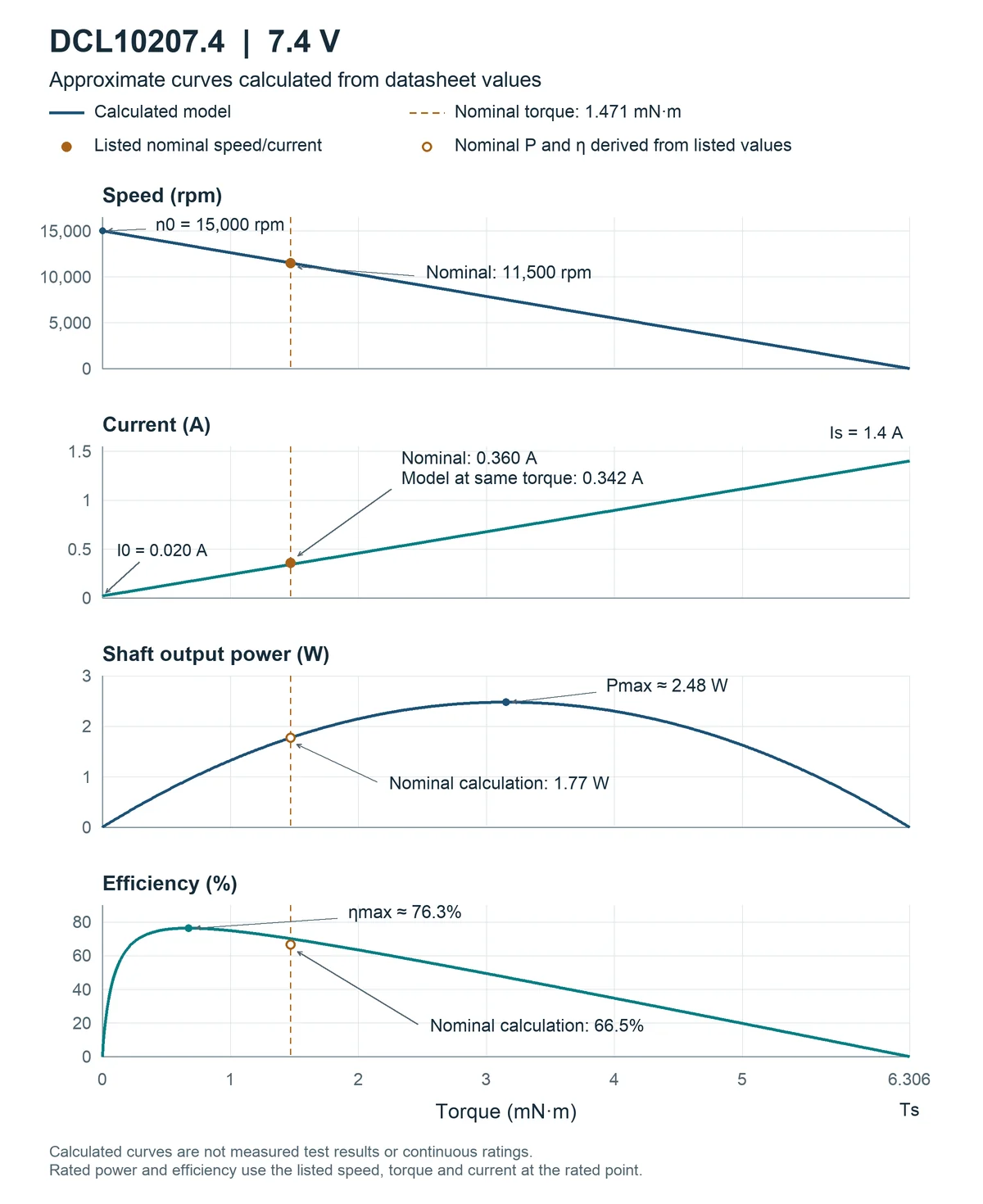
Figure 1. DCL10207.4 at 7.4 V. Curves are calculated from our datasheet endpoints; filled markers identify listed rated speed and current, while open markers show calculated rated power and efficiency. ## Motor constants
Motor constants connect electrical readings with mechanical performance. Their units and current definitions must agree.
| Parameter | Meaning | Reading rule |
|---|---|---|
| Torque constant Kt | Torque per torque-producing current | Use mN·m/A; identify winding current. |
| Back-EMF constant Ke | Generated voltage per speed | State voltage and speed units. |
| Speed constant Kn | Speed per back EMF | Usually rpm/V; n0/U is approximate. |
| Resistance R | Resistance of the specified winding connection | State Ω, temperature and phase or phase-to-phase connection. |
| Mechanical time constant τm | Unloaded speed-response timescale | It is not a permitted running duration. |
For a brushed approximation, T ≈ Kt(I − I0). With compatible definitions, Ke in mV/rpm equals (2π/60)Kt when Kt is in mN·m/A, and Kn = 1,000/Ke. In coherent SI units, Kt and Ke have equal numerical values. RMS, peak and phase-current conventions must be reconciled before applying this to BLDC data.
The simple unloaded model gives τm = JR / (KtKe), where J is rotor inertia. With J in g·cm², R in Ω and Kt in mN·m/A, τm in ms = 100JR/Kt². Our example tables omit R and J, so no numerical time constant is calculated.
## Worked example
The tables below compare our [DCL1020005](https://eurari.com/en/products/brushed-dc-motors/dcl1020005) and [DCL10207.4](https://eurari.com/en/products/brushed-dc-motors/dcl10207-4) brushed motors with our [ECL1636012](https://eurari.com/en/products/brushless-dc-motors/ecl1636012) and [ECL1636024](https://eurari.com/en/products/brushless-dc-motors/ecl1636024) brushless motors. All values are for bare motors. For calculations, 1 gf·cm = 0.0980665 mN·m; 20 mA = 0.020 A.
| Motor model | Rated voltage (VDC) | No-load | Rated | Stall |
|---|---|---|---|---|
| Speed (rpm) | Current (mA) | Speed (rpm) | Torque (gf·cm) | Current (mA) | Power (W) | Torque (gf·cm) | Current (A) |
| DCL1020005 | 5 | 16000 | 35 | 12550 | 15 | 570 | 1.9 | 69.6 | 2.5 |
| DCL10207.4 | 7.4 | 15000 | 20 | 11500 | 15 | 360 | 1.8 | 64.3 | 1.4 |
Table 1. Our DCL1020005 and DCL10207.4 motor data.
| Motor model | Rated voltage (VDC) | No-load | Rated | Stall |
|---|---|---|---|---|
| Speed (rpm) | Current (mA) | Speed (rpm) | Torque (gf·cm) | Current (mA) | Power (W) | Torque (gf·cm) | Current (A) |
| ECL1636012 | 12 | 12000 | 70 | 10800 | 20 | 250 | 2.2 | 200 | 2.65 |
| ECL1636024 | 24 | 12000 | 45 | 10200 | 30 | 180 | 3.2 | 200 | 1.2 |
Table 2. Our ECL1636012 and ECL1636024 motor data. The current readings are on the DC supply side.
For DCL10207.4, the endpoint-derived torque–current slope is 6.3057 / (1.4 − 0.020) = 4.57 mN·m/A, an approximate Kt estimate. At the rated point, 11,500 rpm and 1.471 mN·m give 1.77 W shaft output. Input is 7.4 × 0.360 = 2.664 W, giving 66.5% efficiency. The fitted current curve predicts 0.342 A there, versus the listed 0.360 A; Figure 1 preserves this difference.
The Power column on these datasheets is our design shaft output at the rated point, based on speed × torque. ECL1636024's displayed speed and torque give about 3.14 W, close to its 3.2 W design value. Its DC input is 24 × 0.180 = 4.32 W, including motor and driver losses; calculated motor-and-driver efficiency is 72.7%. We can adjust the winding to meet your application's speed, torque and power requirements.
ECL1636024's rated point also agrees with the endpoint speed–torque line: 12,000 × (1 − 2.942/19.613) ≈ 10,200 rpm. This supports a datasheet-derived maximum-output estimate of about 6.2 W at 6,000 rpm and 9.8 mN·m. Driver current limiting can change that result. It does not justify calculating winding Kt or an efficiency curve from supply-current endpoints.
## Brushed vs brushless datasheets
A directly supplied [brushed motor](https://eurari.com/en/products/brushed-dc-motors) is measured at its terminals. A [brushless motor](https://eurari.com/en/products/brushless-dc-motors) needs electronic commutation. Its controller switches voltage and current, so supply current and winding current are generally different.
Use supply voltage and current for input power. Use the specified winding current for torque and heating calculations. Dividing ECL1636024 stall torque by its supply-current increase produces a fitted ratio, not a physical winding Kt. Record the driver and its current limits when comparing curves; speed regulation can also change their shape.
## A checklist for comparing two datasheets
1. Match model, winding voltage, driver and output shaft.
2. Normalize units and temperature before judging tolerances.
3. Compare speed, torque and current at the required load.
4. Separate shaft output from DC input, including driver losses.
5. Check startup requirements and winding-current limits.
6. Validate cooling, duty cycle and temperature rise.
7. Agree the operating conditions in the specification approval sheet.
## FAQ
### Why does a motor datasheet list two speeds?
No-load speed describes a freely running shaft; rated speed describes the specified loaded point. Choose using speed at your required torque. Meeting an unloaded rpm target does not mean the motor will maintain it while driving your mechanism.
### Does a lower I₀ always mean a more efficient motor?
No. At no external load, useful shaft output is zero. Lower I₀ indicates lower no-load consumption under comparable conditions, but loaded copper losses may still be higher. Compare efficiency at the operating point your application actually uses.
### When does a 7.4 V 1020 motor reach its listed stall current?
With 7.4 V at the terminals and a cold winding, DCL10207.4's stall current is approximately 1.4 A. Starting current can approach this value before the motor accelerates; a jammed shaft sustains a stall condition. Current does not jump instantly to 1.4 A at switch-on. Winding heating, voltage drop and supply or driver limits reduce it.
### Is there one safe current or temperature limit for small DC motors?
No. Winding construction, cooling, duty, bearings and electronics determine the limits. Insulation class alone is insufficient. Use the agreed operating conditions and temperature-rise results for your model, including repetitive starts and the actual enclosure.
### Can efficiency be calculated from stall torque and no-load speed alone?
No. Those endpoints estimate maximum shaft output under a linear speed–torque model. Efficiency also needs electrical input at the same point. For brushless motors, include driver losses when the input is measured at the DC supply.
[Send us](https://eurari.com/en/contact) your required speed, torque, voltage, duty cycle and cooling conditions. Once samples are approved, we issue a formal specification approval sheet with measured performance curves under your operating conditions.
## Technical references
1. [OpenStax — University Physics Volume 2, Resistivity and Resistance](https://openstax.org/books/university-physics-volume-2/pages/9-3-resistivity-and-resistance)
2. [EURARI — Can You Run a 12V Brushless DC Motor on 9V?](https://eurari.com/en/blog/can-a-12v-bldc-motor-run-on-9v)
3. [EURARI — DCL10207.4 specifications](https://eurari.com/en/products/brushed-dc-motors/dcl10207-4)
4. [EURARI — ECL1636012 specifications](https://eurari.com/en/products/brushless-dc-motors/ecl1636012)
5. [EURARI — ECL1636024 specifications](https://eurari.com/en/products/brushless-dc-motors/ecl1636024)
6. [EURARI — DCL1020005 specifications](https://eurari.com/en/products/brushed-dc-motors/dcl1020005)
7. [Northwestern University — Brushed DC Motor Theory](https://hades.mech.northwestern.edu/index.php/Brushed_DC_Motor_Theory)
8. [maxon — Motor controllers: Input current versus Motor current, Power Conversion](https://support.maxongroup.com/hc/en-us/articles/360016161594-Motor-controllers-Input-current-versus-Motor-current-Power-Conversion)
```json
{
"@context": "http:\/\/schema.org",
"@graph": [
{
"@type": "FAQPage",
"author": {
"@id": "https:\/\/eurari.com\/#editor_27833254a6"
},
"dateModified": "2026-11-11T07:27:48Z",
"datePublished": "2026-11-11T07:08:38Z",
"headline": "How to Read a DC Motor Datasheet",
"inLanguage": "en-GB",
"mainEntity": [
{
"@type": "Question",
"name": "Why does a motor datasheet list two speeds?",
"acceptedAnswer": {
"@type": "Answer",
"text": "No-load speed describes a freely running shaft; rated speed describes the specified loaded point. Choose using speed at your required torque. Meeting an unloaded rpm target does not mean the motor will maintain it while driving your mechanism.<\/p>"
}
},
{
"@type": "Question",
"name": "Does a lower I₀ always mean a more efficient motor?",
"acceptedAnswer": {
"@type": "Answer",
"text": "
No. At no external load, useful shaft output is zero. Lower I₀ indicates lower no-load consumption under comparable conditions, but loaded copper losses may still be higher. Compare efficiency at the operating point your application actually uses.<\/p>"
}
},
{
"@type": "Question",
"name": "When does a 7.4 V 1020 motor reach its listed stall current?",
"acceptedAnswer": {
"@type": "Answer",
"text": "
With 7.4 V at the terminals and a cold winding, DCL10207.4's stall current is approximately 1.4 A. Starting current can approach this value before the motor accelerates; a jammed shaft sustains a stall condition. Current does not jump instantly to 1.4 A at switch-on. Winding heating, voltage drop and supply or driver limits reduce it.<\/p>"
}
},
{
"@type": "Question",
"name": "Is there one safe current or temperature limit for small DC motors?",
"acceptedAnswer": {
"@type": "Answer",
"text": "
No. Winding construction, cooling, duty, bearings and electronics determine the limits. Insulation class alone is insufficient. Use the agreed operating conditions and temperature-rise results for your model, including repetitive starts and the actual enclosure.<\/p>"
}
},
{
"@type": "Question",
"name": "Can efficiency be calculated from stall torque and no-load speed alone?",
"acceptedAnswer": {
"@type": "Answer",
"text": "
No. Those endpoints estimate maximum shaft output under a linear speed–torque model. Efficiency also needs electrical input at the same point. For brushless motors, include driver losses when the input is measured at the DC supply.<\/p>"
}
}
],
"mainEntityOfPage": {
"@type": "WebPage",
"url": "https:\/\/eurari.com\/en\/blog\/how-to-read-dc-motor-datasheet"
},
"url": "https:\/\/eurari.com\/en\/blog\/how-to-read-dc-motor-datasheet"
},
{
"@type": "BlogPosting",
"author": {
"name": "EURARI Engineering Team",
"url": "https:\/\/eurari.com\/en\/about",
"@type": "Person"
},
"dateModified": "2026-11-11T07:27:48Z",
"datePublished": "2026-11-11T07:08:38Z",
"description": "Learn how to read a DC motor datasheet: test conditions, no-load, rated and stall points, Kt, and maximum power vs efficiency, with real motor examples.",
"headline": "How to Read a DC Motor Datasheet",
"image": [
{
"@type": "ImageObject",
"url": "https:\/\/eurari.com\/images\/blog\/2026\/dcl10207-4-characteristic-curves-en.webp",
"caption": null,
"description": "DCL10207.4 at 7.4 V: calculated speed, current, shaft output power and efficiency versus torque, marking no-load, rated, maximum power, maximum efficiency and stall points",
"width": 1200,
"height": 1470
}
],
"inLanguage": "en-GB",
"mainEntityOfPage": {
"@type": "WebPage",
"url": "https:\/\/eurari.com\/en\/blog\/how-to-read-dc-motor-datasheet"
},
"publisher": {
"@id": "https:\/\/eurari.com\/#defaultPublisher"
},
"url": "https:\/\/eurari.com\/en\/blog\/how-to-read-dc-motor-datasheet"
},
{
"@type": "Person",
"name": "Editor",
"@id": "https:\/\/eurari.com\/#editor_27833254a6"
},
{
"@id": "https:\/\/eurari.com\/#defaultPublisher",
"@type": "Organization",
"url": "https:\/\/eurari.com\/",
"logo": {
"@id": "https:\/\/eurari.com\/#defaultLogo"
},
"name": "EURARI",
"location": {
"@id": "https:\/\/eurari.com\/#defaultPlace"
}
},
{
"@id": "https:\/\/eurari.com\/#defaultLogo",
"@type": "ImageObject",
"url": "https:\/\/eurari.com\/images\/company\/EURARI_logo_white.png",
"width": 627,
"height": 627
},
{
"@id": "https:\/\/eurari.com\/#defaultPlace",
"@type": "Place",
"address": {
"@id": "https:\/\/eurari.com\/#defaultAddress"
}
},
{
"@id": "https:\/\/eurari.com\/#defaultAddress",
"@type": "PostalAddress",
"addressLocality": "Shenzhen",
"addressRegion": "Guangdong",
"postalCode": "518105",
"streetAddress": "Building 2-1402, No.162 Shajiang Rd, Songgang, Bao'an District,",
"addressCountry": "CN"
}
]
}
```